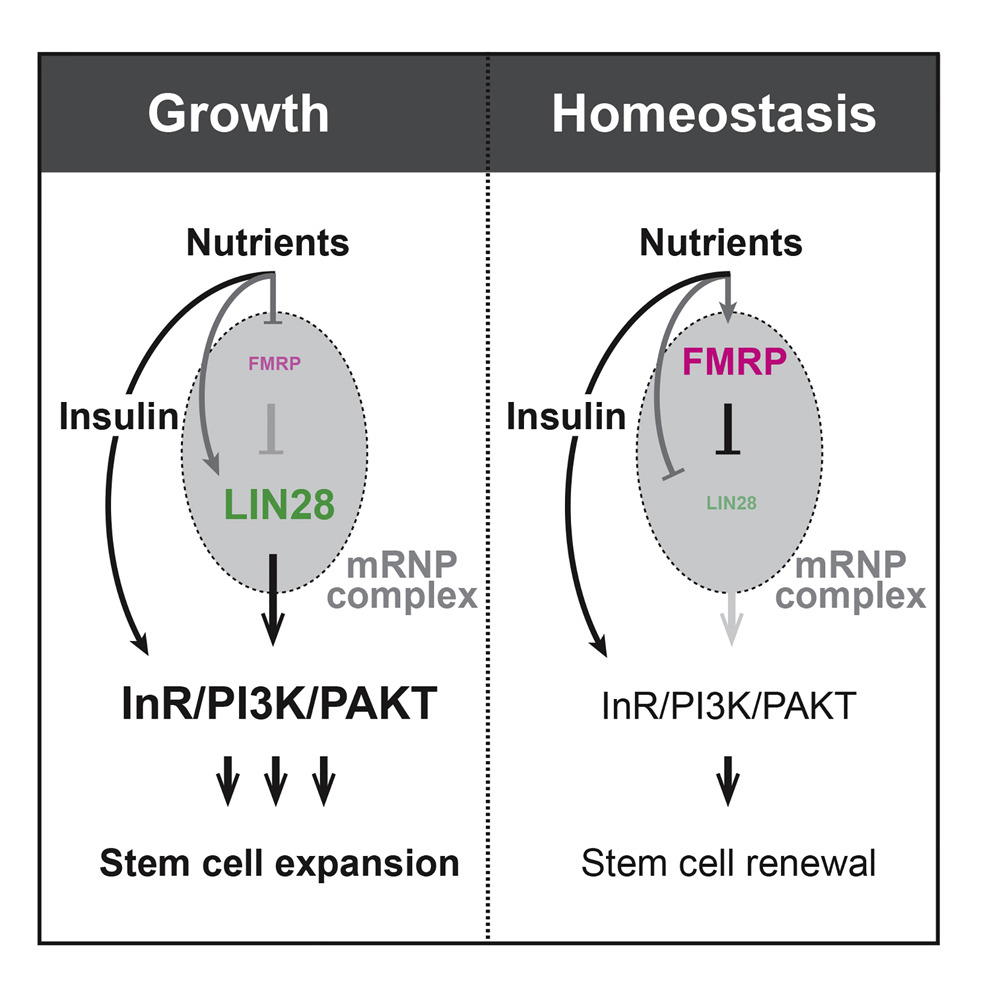
Opposing Post-transcriptional Control of InR by FMRP and LIN-28 Adjusts Stem Cell-Based Tissue Growth
Introduction
In this story we describe how two RNA-binding proteins, LIN-28 and FMRP, regulate the behavior of intestinal stem cells of adult Drosophila. Given below are the highlights of the study:
Highlights
- FMRP limits adaptive tissue expansion in the adult Drosophila intestine
- FMRP represses symmetric division and insulin sensitivity of intestinal stem cells
- FMRP mediates its effect in intestinal stem cells solely via LIN-28
- FMRP acts via LIN-28 to post-transcriptionally repress insulin-like receptor (InR)
Here is the abstract of the manuscript:
Abstract
Although the intrinsic mechanisms that control whether stem cells divide symmetrically or asymmetrically underlie tissue growth and homeostasis, they remain poorly defined. We report that the RNA-binding protein fragile X mental retardation protein (FMRP) limits the symmetric division, and resulting expansion, of the stem cell population during adaptive intestinal growth in Drosophila. The elevated insulin sensitivity that FMRP-deficient progenitor cells display contributes to their accelerated expansion, which is suppressed by the depletion of insulin-signaling components. This FMRP activity is mediated solely via a second conserved RNA-binding protein, LIN-28, known to boost insulin signaling in stem cells. Via LIN-28, FMRP controls progenitor cell behavior by post-transcriptionally repressing the level of insulin receptor (InR). This study identifies the stem cell-based mechanism by which FMRP controls tissue adaptation, and it raises the possibility that defective adaptive growth underlies the accelerated growth, gastrointestinal, and other symptoms that affect fragile X syndrome patients.
Further Reading
If you are interested, please read the full story that is freely available here.
Cite this work
Luhur A, Buddika K, Ariyapala IS, Chen S, Sokol NS. Opposing Post-transcriptional Control of InR by FMRP and LIN-28 Adjusts Stem Cell-Based Tissue Growth. Cell Reports. 2017 Dec 5;21(10):2671-2677. doi: 10.1016/j.celrep.2017.11.039. PMID: 29212015; PMCID: PMC5728658.